Upcoming Linguistic Events

Find below a list of upcoming events dedicated to languages and cultures. Please note that it is not solely meant for professional linguists. Although it is mainly aimed at translators, LSPs, teachers, or any other language specialists, anyone interested in the subject is more than welcome!

October 2014

15th to 18th | The 5th Int’l Conference on Dual Language/Immersion Education in Salt Lake City (USA)

20th to 21st | Language Education Conference (LEC 2014)  in Nilai (Malaysia)

27th to 28th | International Conference on Languages and the Market: Competitiveness and Employability in Estoril (Portugal)

November 2014

01st to 02nd | AUSIT Biennial Conference’14 Transition Into the Future  in Brisbane (Australia)

12th to 13th | International Conference on Education, Culture and Society  in Toronto (Canada)

December 2014

11th to 13th | 2nd Global Conference on Linguistics and Foreign Language Teaching  in Dubai (United Arab Emirates)

15th to 17th | Int’l Conference on language, literature & culture 2014 in Pune, Maharashtra (India)

16th to 17th | International Conference on Language, Literature, Culture, and Education  in London (United Kingdom)

The status of French in the world

The French Ministry of Foreign Affairs and International Development has recently published an enlightening article that will show you how important it is to have your content translated into French.

French is widely spoken all over the world, with more than 220 million speakers on all 5 continents! It is taught in many countries. It is the official language of a myriad of international entities, including UN bodies and the Olympic Games.

French is an official language of 29 countries, second only to English in this category.

From a business perspective, it is also a language of reference that has to be reckoned with. So it is crucial to address your potential French-speaking clients in French. Think globally but act locally!

France and the French-speaking countries play an active part in the world economy, accounting for some 20% of world trade in goods.

As mentioned in previous posts, it is crucial to address new markets using the local language. It has been proven that localisation leads to a higher conversion rate. Consequently, having your website, business literature, press releases (among other documents) translated into French is crucial to engage successfully in French markets.

French also accounts for 5% of Internet pages, ranking between sixth and eighth of the languages most widely used on the Internet.

Find the whole article here: http://www.diplomatie.gouv.fr/en/french-foreign-policy-1/promoting-francophony/the-status-of-french-in-the-world/

Translate Your Online Content in French

Social media have changed the way people communicate and companies do business. It can no longer be overlooked when a company tries to reach new customers and/or investors. When referring to social media and online content, I’m speaking about websites, blogs, Twitter, Google+, Facebook,  Youtube, Pinterest, Instagram, etc.

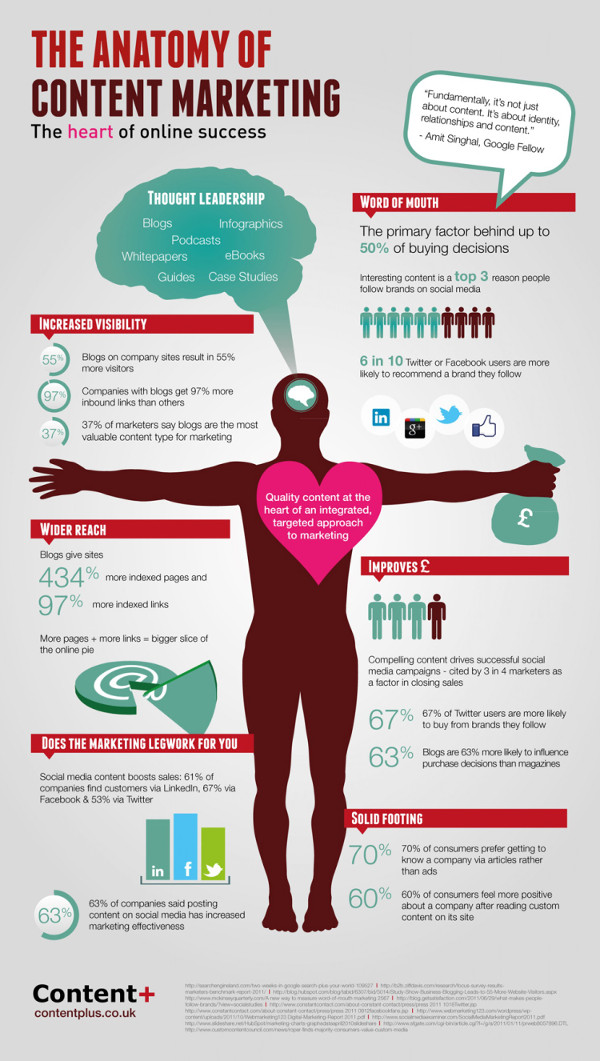
Through all of them, you can reach an outstanding number of potential clients, especially the younger generation. To have a better understanding of the impact of such networks, check out the numbers in one of my recent blogs showing an infographic about content marketing and how such strategy impacts online success. To see that infographic again, please click here.

63% of companies said posting content on social media has increased marketing effectiveness.

And make no mistake, English is definitely not the sole language used on social media. Still unsure whether you should translate? Watch this video « Social Media Revolution », it’s compelling:

Language among Top 5 Barriers to Doing Business

The Australian Trade Commission (Austrade) published and recently updated its AIBS 2014 report (Australia’s International Business Survey), one of the most comprehensive investigations into Australian international business activity to be conducted in more than a decade.

The survey found that one of the top obstacles to doing business and/or accessing markets is a lack of information about local culture, business practices and language.

Therefore, translation should be seen as an investment, not a cost. Good communication is key to success on a global scale.

For more information, read the complete survey report here.

For highlights report, click here.

Translating Corporate Websites in 4 Steps

Are you looking to have your website translated?

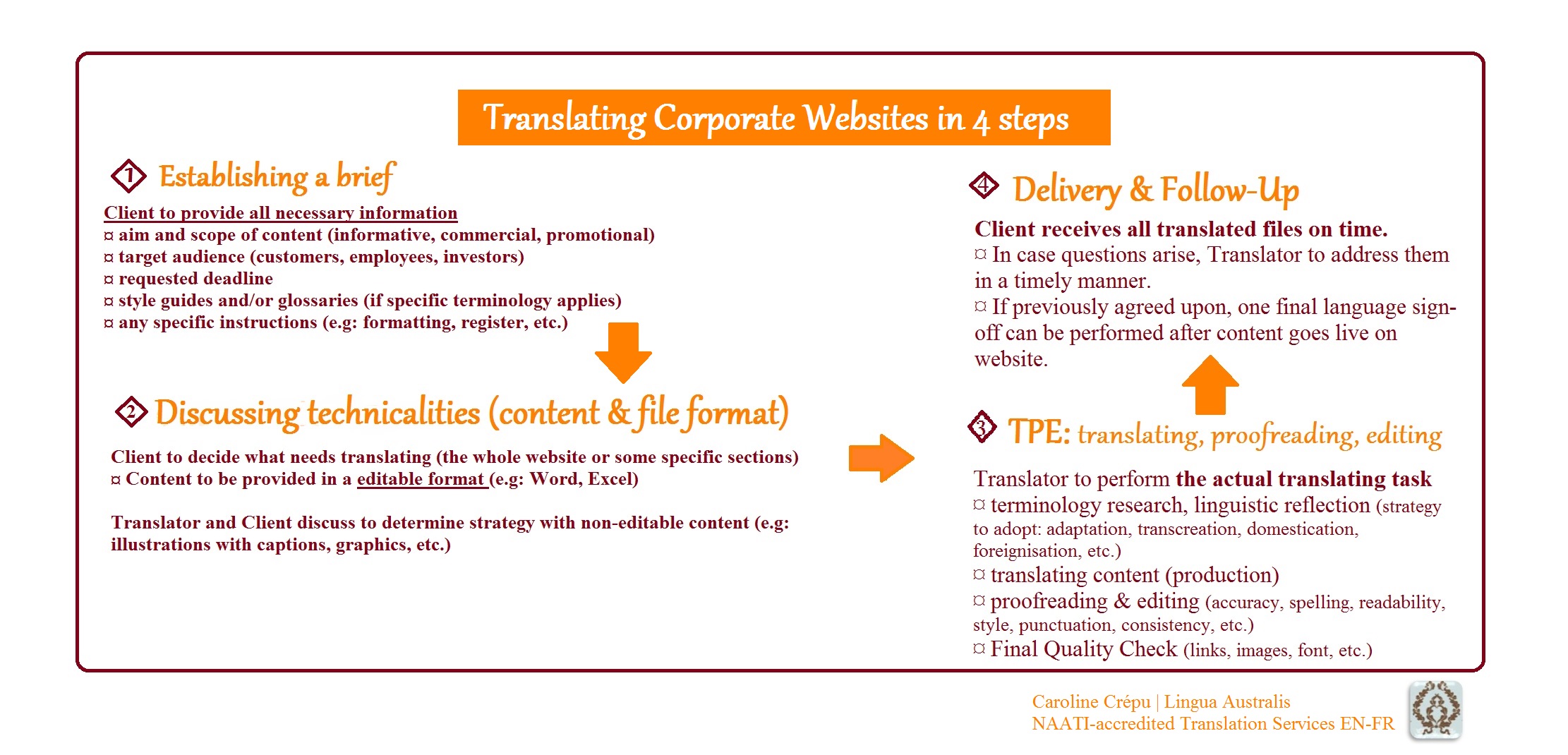
Your communication online is key to your success in the global market. To ensure top quality of your content, trust the expertise of a professional translator. To better understand the whole work that goes into handling successfully a translation project, see below the infographic I created especially for you. Click on the image to enlarge.

For more details and/or a free quote, contact me through my Contact Page.

Infographic Translating Websites

The importance of multilingual content marketing

Do you know how important content marketing is?

Companies willing to boost their sales shouldn’t overlook blogs and social media. According to this article « The anatomy of content marketing »: blogs give sites 434% more indexed pages and 67% of Twitter users are more likely to buy more brands they follow.

Therefore, it’s crucial to communicate online, and above all, to communicate in your customers’ language. Don’t hesitate to publish blogs, tweets, Facebook posts, newsletter articles in several languages. You’ll broaden your footprint and reach a much wider audience.

These compelling numbers were published in a very informative infographic to illustrate the power of marketing content.

AnatomyofContentSource: article on prdaily.com.

NAATI-stamped French Translations

In need of NAATI-stamped translations of your personal documents?

The Australian authorities sometimes require certified translations of personal documents for official administrative use.

I can provide NAATI-stamped translations of your CV, diplomas, degrees, birth and/or marriage certificates, driving licence, etc.

Please note that I only provide stamped translations in the following language direction: English into French.

If your documents need to be translated into English, please visit the online directory curated by NAATI (http://www.naati.com.au/)

On Offering Business Content in French

What are the benefits of having your documents translated?

You may not realise it, but it’s actually crucial to address potential (and existing) clients in their own language. You’re more likely to drive your conversion rate and bottom line if you decide beforehand to invest in translating your business literature: brochures, press releases, website, emails, newsletter, social media communication plan, etc.

Have you noticed that, when travelling, the locals always respond very favourably when you make a small effort and try saying a few words in the local language? The same applies in the business world. But this time, you need to go the professional route and contact a professional translator to ensure an error-free translation.

Translating isn’t a cost, it’s an investment. By offering well-targeted and nicely-worded content, you’ll give your company a powerful image and an international footprint.

Don’t hesitate to contact me through my « Contact Page » for more details and/or a free quote.

On the process of translation

If you live outside the translation sphere, you’d probably think it is a simple task consisting of changing words for others. Well, you’ll be surprised to find out that it’s so much more than that.

I found a great infographic depicting the whole process that goes into translating. From the research needed beforehand to the proofreading and editing steps, handling translation projects is a wide and massive task requiring time and reflection.

To have a look at the document, please click here. The website is curated by Clara Giampietro from Winged Translations.

If I had a piece of advice to give to clients willing to have their business literature translated, it would be to, first and foremost, establish some kind of brief with the following elements: the aim of the documents (informative, commercial, promotional,etc), the target audience (employees, customers, investors, etc), deadline and specifics about formatting and/or terminology. Also, if your company has a very specific terminology that needs to be abided by, then it’s of the utmost importance to provide your translator with the necessary references (glossaries, style guides, past translation projects for consistency purposes).

Preparing a translation project should be like preparing an ad campaign, it should be well thought-out and accurately targeted to ensure optimal results.

Clients and translators need to work hand in hand to ensure a project is successful. Communication is key!

De la difficulté de traduire

Selon un classement publié sur le site themuse.com, le métier de traducteur et/ou interprète se classe à la 4e place des métiers à domicile les plus lucratifs, un constat assorti d’un point crucial, le niveau de compétences qui est estimé, à juste titre, « très élevé ». Le site décrit la profession comme suit :

« [Translators] work on special projects that are suited to their talents and areas of knowledge »

En plus d’excellentes qualités rédactionnelles, un traducteur doit effectivement posséder de très bonnes connaissances des secteurs pour lesquels il traduit des documents.  Cette profession requière autant de qualités scientifiques (factuelles) que de compétences artistiques (rédactionnelles). Malheureusement, cette profession étant dérèglementée, n’importe qui peut s’improviser traducteur. Par conséquent, il n’est pas étonnant que l’on se retrouve parfois face à des traductions peu satisfaisantes, voire même un florilège d’erreurs dont les conséquences peuvent être retentissantes. En ce 2 septembre, une erreur historique refait la une, celle de la traduction du mot japonais « mokusatsu » lors de la 2e guerre mondiale (http://www.slate.fr/story/91073/mokusatsu-erreur-traduction-seconde-guerre-mondiale). Cet article très intéressant aborde la difficulté de traduire des termes très ambigus dans le cadre des relations diplomatiques, un exercice de haut vol.

Comment traduire avec justesse des termes ambivalents, sachant que le choix pourrait avoir des répercussions fatales ? Une situation complexe autant sur le plan intellectuel qu’éthique. Imaginez la scène avec cette note de la NSA :

“Mais que voulez-vous dire par: ‘Mokusatsu peut signifier ‘Sans commentaire’ ou ‘Ignorer avec mépris’?!’ Nom de dieu soldat, je ne peux pas aller voir le chef des forces armées avec ça! Je dois lui donner des faits précis, pas un questionnaire à choix multiples! Alors vous vous remettez au boulot et vous me donnez une traduction valable »

Dans un autre contexte, on observe parfois que certains ont un recours plus que léger à des outils peu fiables comme Google Translate, ce qui se traduit par des erreurs gravées dans le marbre (ou le granit dans ce cas-là). Au Canada,  une traduction incompréhensible du poème When I Think of Famous Men de sir Stephen Spender a été gravée sur une façade d’un nouveau monument érigé dans un cimetière militaire à Ottawa. Pour consulter l’article, cliquez ici.

L’utilisation de certains outils est donc à éviter par respect pour la profession d’une part, mais surtout pour le public cible qui mérite de lire un texte compréhensible. En revanche, le recours au correcteur orthographique devrait être, lui, encouragé. Voici un autre exemple d’erreurs gravées dans le marbre : Cela se passe à Ferney-Voltaire, une petite commune dans la région Rhône-Alpes (France). Des plaques gravées de plusieurs citations de Voltaire ont été installées sur l’allée classée menant au château du philosophe. Problème : des fautes d’orthographe ou de syntaxe ponctuent les citations de l’écrivain du Siècle des Lumières. Des erreurs gravées dans le bronze ! Vous pouvez regarder le reportage en cliquant ici.

L’erreur est humaine, ça peut arriver à tout le monde, même aux linguistes les plus érudits. Mais, l’étape de la relecture ne devrait jamais être considérée comme facultative. Exprimer un message c’est bien, mais la forme compte autant que le fond, n’est-ce pas ?

https://twitter.com/Grammarly/status/504247040701132800